> For the complete documentation index, see [llms.txt](https://docs.pascom.net/llms.txt). Markdown versions of documentation pages are available by appending `.md` to page URLs; this page is available as [Markdown](https://docs.pascom.net/en/reference/howto/update-automation-with-powershell-script.md).
# Update automation with PowerShell-Script
In this HowTo you will learn how to automate the update process with the help of a PowerShell-Script.
In this HowTo, we will show you how to automate the update process of the PASCOM app with a PowerShell script. The PowerShell script can be executed manually by simply downloading and starting it via PowerShell, or automatically using the Windows Task Scheduler. Automation saves you time and ensures that your PASCOM apps are always up to date.
#### Download
{% file src="/files/CNxl7kAFuxLqyEUcTsla" %}
Get the PowerShell-Script
{% endfile %}
{% hint style="success" %}
Save the PowerShell script in a location where you can easily access the path to the file later.
{% endhint %}
#### Unblock File
If you have loaded the script onto the terminal server via a web browser, you may have to remove the **Zone.Identifier** before you can execute the script”.
```
Unblock-File -Path .\autoUpdate.ps1
```
#### Permissions
The script should be executed with the same permissions that were used during the original installation of the PASCOM app. Administrator rights are therefore required for the [recommended installation method](/en/operations/clients.md) on a terminal server.
## Manual update of the PASCOM apps with the PowerShell script
* Open **PowerShell**
* Press Win + R to open the Run dialogue box. Type **powershell** and press Enter.
* Navigate to the directory where the script is located.
Example:
```
cd C:\path\to\your\script
```
* Now that you are in the directory where the PowerShell script is located, you can simply run it.
* Enter the name of the .ps1 file to execute the script.
Example:
```
.\autoUpdate.ps1
```
* Done. The update process starts
## Automatic update of the PASCOM apps with the Windows Scheduler
* Open the **Windows Task Scheduler**
* Press Win + R to open the Run dialogue box. Type **taskschd.msc** and press Enter.
* Create a new **"basic task"**-
* Define a time at which the task should be triggered.
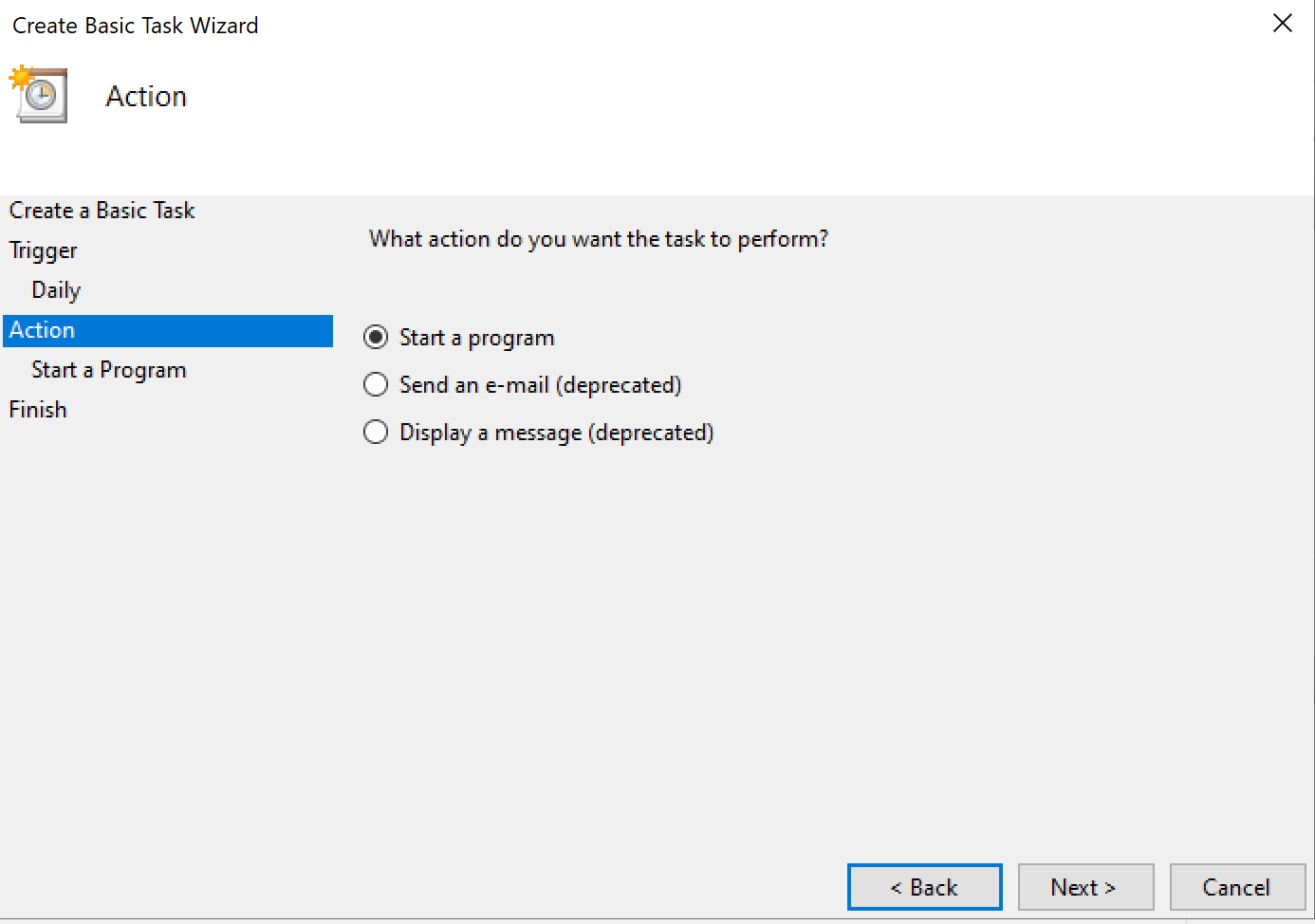
* Configure a new **"Action"**.
* The action should open a application - **"Start a program"**.
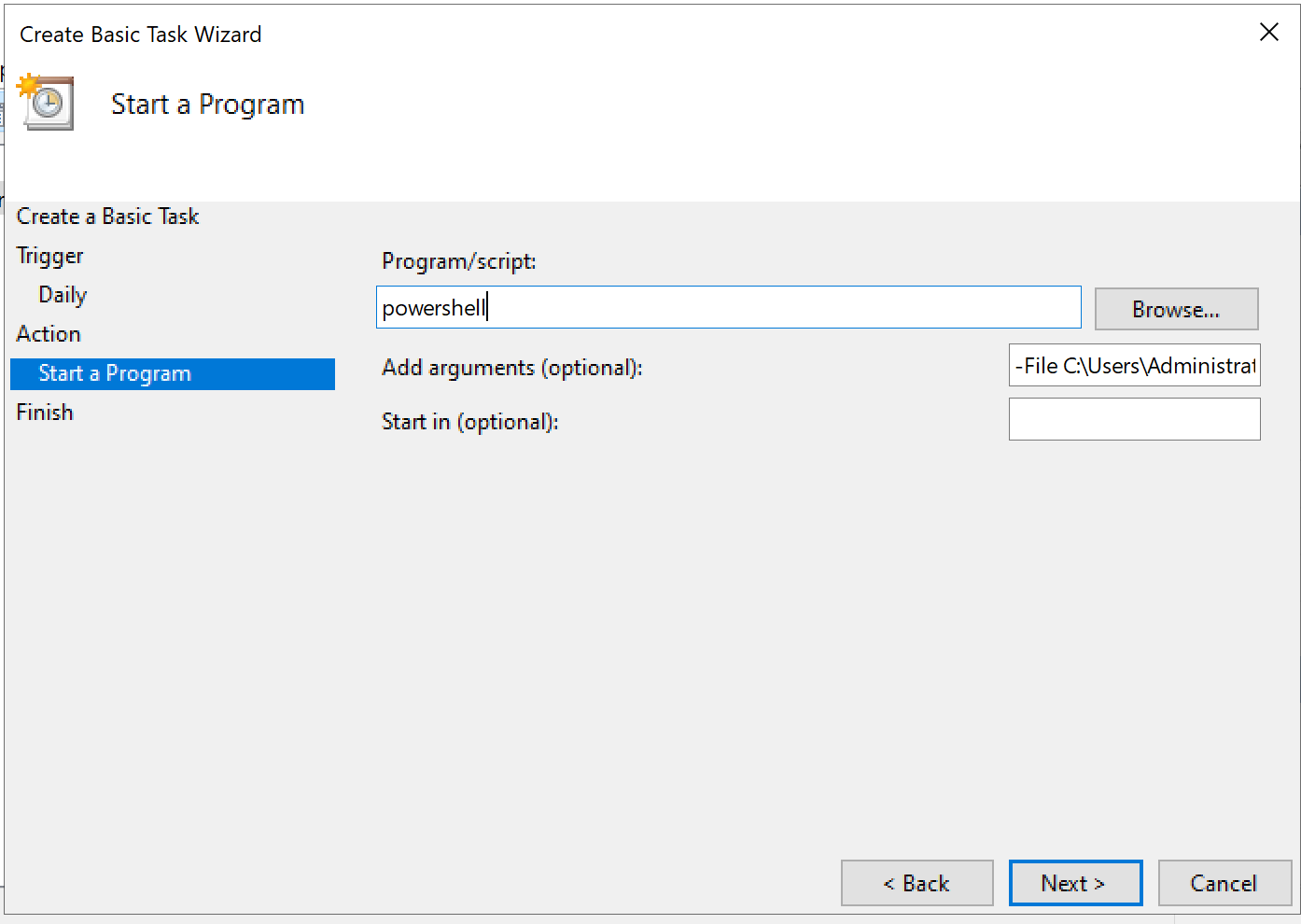
* PowerShell must now be opened. Enter the command **powershell** in the "Program/Script" field.
* You also need an argument/parameter. Enter the path to your .ps1 file here.
Example:
```
-File C:\path\to\your\script\autoUpdate.ps1
```
* Done. You can perform a manual test run of the task to test whether the PASCOM app is updated correctly.
---
# Agent Instructions
This documentation is published with GitBook. GitBook is the documentation platform designed so that both humans and AI agents can read, navigate, and reason over technical content effectively. Learn more at gitbook.com.
## Querying This Documentation
If you need additional information that is not directly available in this page, you can query the documentation dynamically by asking a question.
Perform an HTTP GET request on the following URL with the `ask` and `goal` query parameters:
```
GET https://docs.pascom.net/en/reference/howto/update-automation-with-powershell-script.md?ask=&goal=
```
`ask` is the immediate question: it should be specific, self-contained, and written in natural language.
`goal` is what the user is ultimately trying to achieve, the reason they need the answer. Sharing it helps GitBook give you a better, more relevant answer. A goal is most helpful when it describes the outcome the user wants rather than restating the question. For example, with `ask=how do I create an API token`, a goal like `build a script that syncs our docs to a CMS` lets GitBook tailor the answer to that use case.
The response will contain a direct answer to the question and relevant excerpts and sources from the documentation.
Use this mechanism when the answer is not explicitly present in the current page, you need clarification or additional context, or you want to retrieve related documentation sections.