> For the complete documentation index, see [llms.txt](https://docs.pascom.net/llms.txt). Markdown versions of documentation pages are available by appending `.md` to page URLs; this page is available as [Markdown](https://docs.pascom.net/en/account/mypascom-userguide/porting-problems.md).
# Reasons for rejection during porting and how to avoid them
Here you will find useful information on reasons for rejection that can occur during porting and how to avoid these problems.
## Intro
Number porting allows users to transfer their telephone number from one provider to another without changing the number. However, there are certain reasons why number porting can be rejected. To avoid such rejections, it is important to consider a few things in advance. By entering your data carefully and paying attention to the following aspects, you can minimize the risk of a number porting rejection and ensure a smooth change of telecommunications provider.
## Incorrect contractual data
In the number porting process, it is crucial that the porting request contains complete and correct information on the contractual data stored with the transferring provider. Incomplete or incorrect provision of this data can lead to rejection of the porting request and hinder a smooth change of telecommunications provider.
Here, the **"contractual data "** refers to the information that the originating provider has stored about the owner of the telephone number. This usually includes personal identification data such as **name, address and contact details**. For the porting process to be successful, this data in the porting request must exactly match the information held by the current provider in its databases.
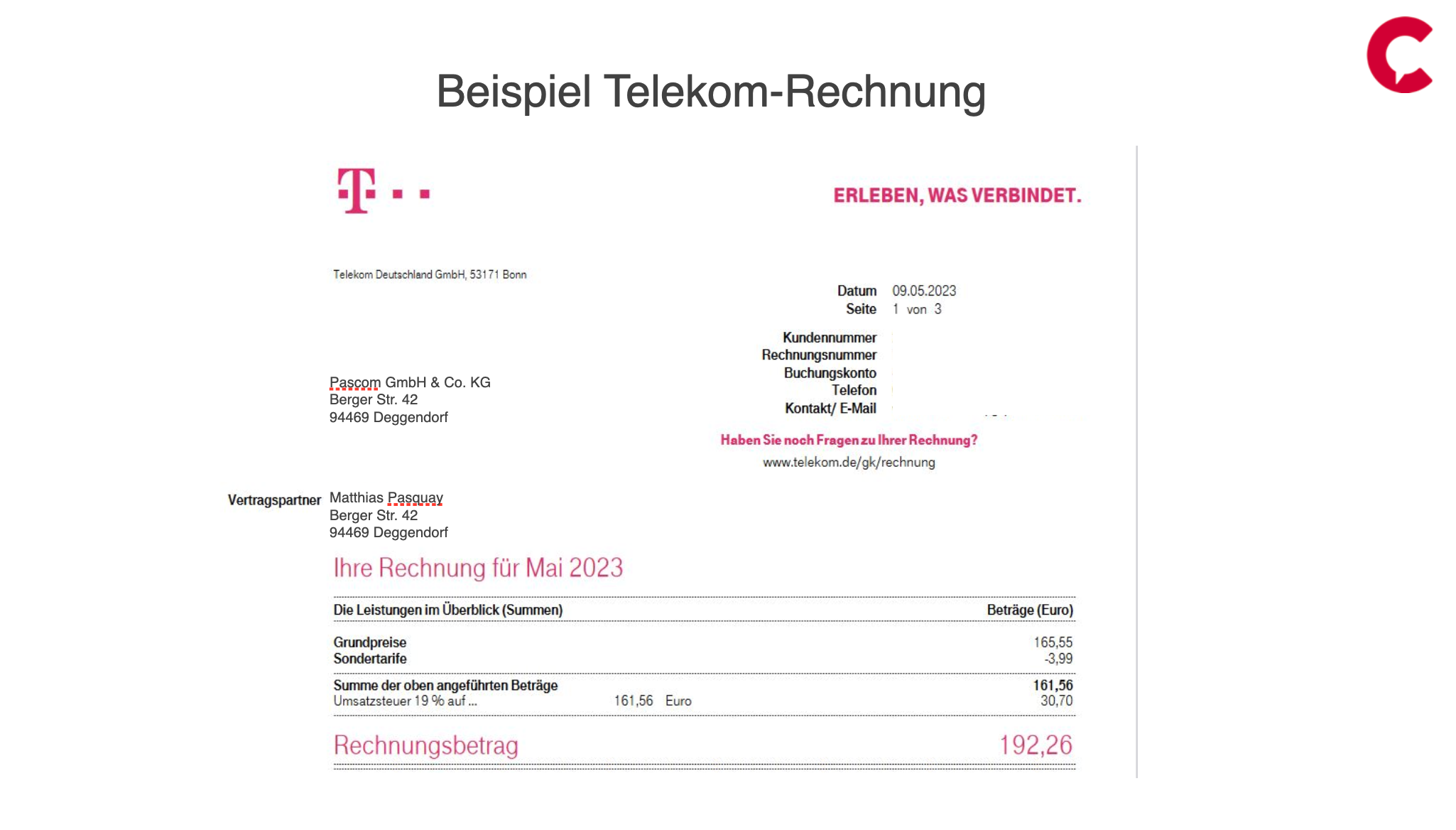
### Invoice recipient is not always the same as contractual partner
The separation between the bill recipient and the contractual partner is an important aspect of number portability. In many cases, the telephone bill is issued to a specific person or organization that acts as the bill recipient. However, this is not necessarily the same person or organization that concluded the actual contract with the telecommunications provider.
1. **Bill recipient:** The bill recipient is the person or organization that receives the telephone bill and is responsible for the financial aspects of the telephone contract. This role may change, for example if a telephone number is transferred from one person to another, while the bill continues to go to the original person.
2. **Contractual partner:** The contractual partner is the person or organization that has concluded the actual contract with the telecommunications provider. This person or organization is responsible for all contractual agreements, services and possible terms.
With regard to number porting, it is important to note that **the porting request must contain the information of the contract partner**, but not that of the bill recipient. This means that the details that are stored with the transferring provider as contract partner data must be correctly specified in the porting request.
### The stumbling block of changing the name - often only the billing address is changed
In the event of a change of name or company, sometimes only the billing address changes with the telecommunications provider. This can lead to problems with number porting, as the porting information relates to the contractual partner and not to the billing address.
To avoid such problems, it is important that companies not only update the billing address when changing companies, but also ensure that **the contract partner data** with the telecommunications provider is correct and up-to-date.
### SOLUTION - Previous synchronization of contract partner data
**With a master data query from the current provider**
To avoid rejections during number porting, it is advisable to compare the contract partner data in the porting application with the information held by the current provider in its databases in advance. This **preliminary master data query** ensures that the contract partner data specified in the porting application exactly matches the information stored by the current provider.
If it is determined during the comparison that the contract partner data is no longer up-to-date (e.g. due to name changes, name changes or other changes), an update should be made with the current provider. Timely updating minimizes the risk of rejection, as the contract partner data in the porting application matches the current data.
**Consult contract conclusion documents or previous porting forms**
Previous contract documents can be a great help when porting numbers, as they can serve as a reference and support the accuracy of the contract partner data provided in the porting request.
Overall, **previous contract documents** provide a reliable source of the required information about the contract partner. Using these documents minimizes the likelihood of rejections during number porting, as the data provided in the porting request matches the historical contract information. It is therefore advisable to collect these documents and ensure that they are available for the porting process if required.
## Wrong phone numbers
Incorrect telephone number details when porting can lead to a rejection, as the identity of the transferred telephone number cannot be clearly established. The porting process requires a precise match of information to ensure that the number is legally and correctly transferred from one telecommunications provider to another.
The **accurate and correct provision of telephone numbers** is crucial in the porting process to ensure smooth procedures and avoid possible rejections. You should therefore ensure that the telephone numbers specified in the porting application match the data stored with the current provider exactly.
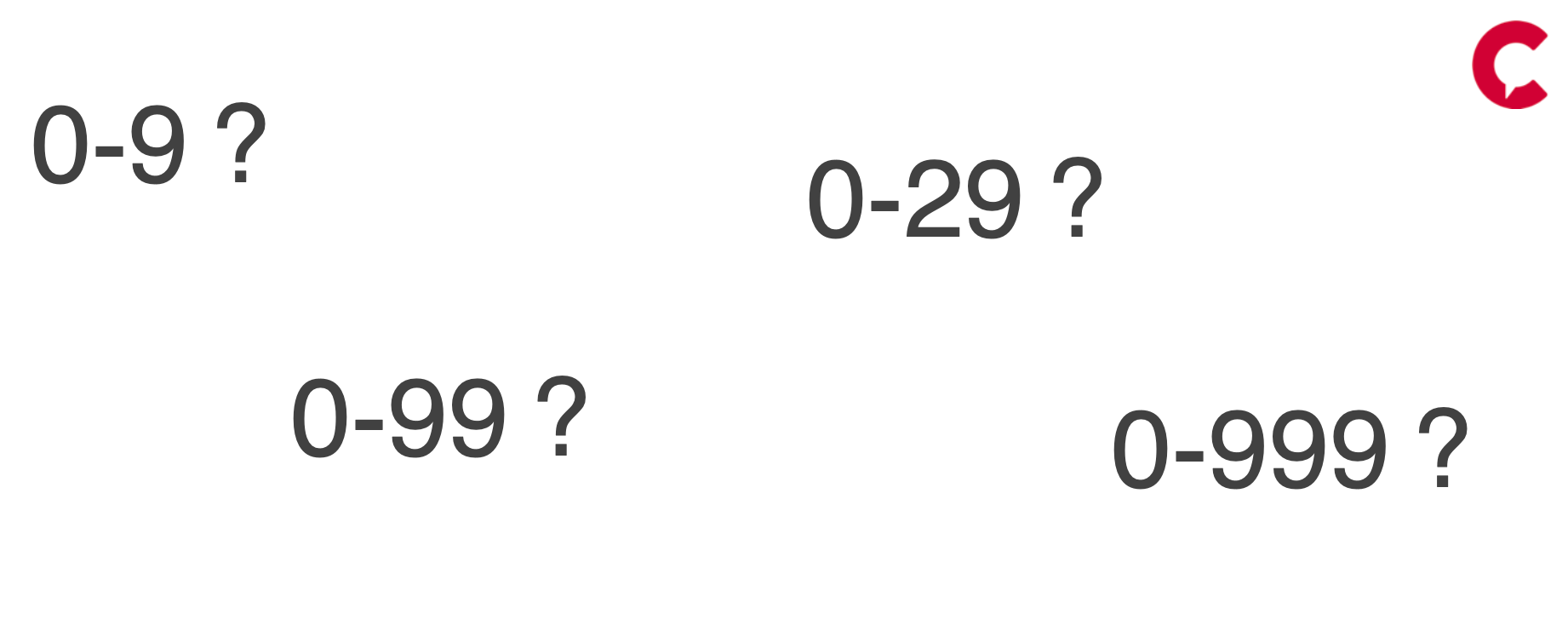
### Size of the call number block is unknown
The porting process requires clear identification of the phone numbers that are to be transferred from one provider to another. If the size of the number block is not known, this could lead to difficulties in accurately identifying the numbers to be ported.
The transferring provider must be informed of the exact size of the number block to be ported in order to carry out the porting process properly. If this is not the case, an inadequate reconciliation will be generated, which may lead to the porting request being rejected.
### Are you talking about individual numbers or a number block?
The type of number **(single number or extension**) has an impact on the technical requirements for porting. The exact nature of the number to be ported must be agreed between the transferring provider and the new provider. The single number and the extension range require different procedures for identifying and assigning the numbers to be ported.
Clear communication and precise information about the type of number help to avoid rejections in the porting process.
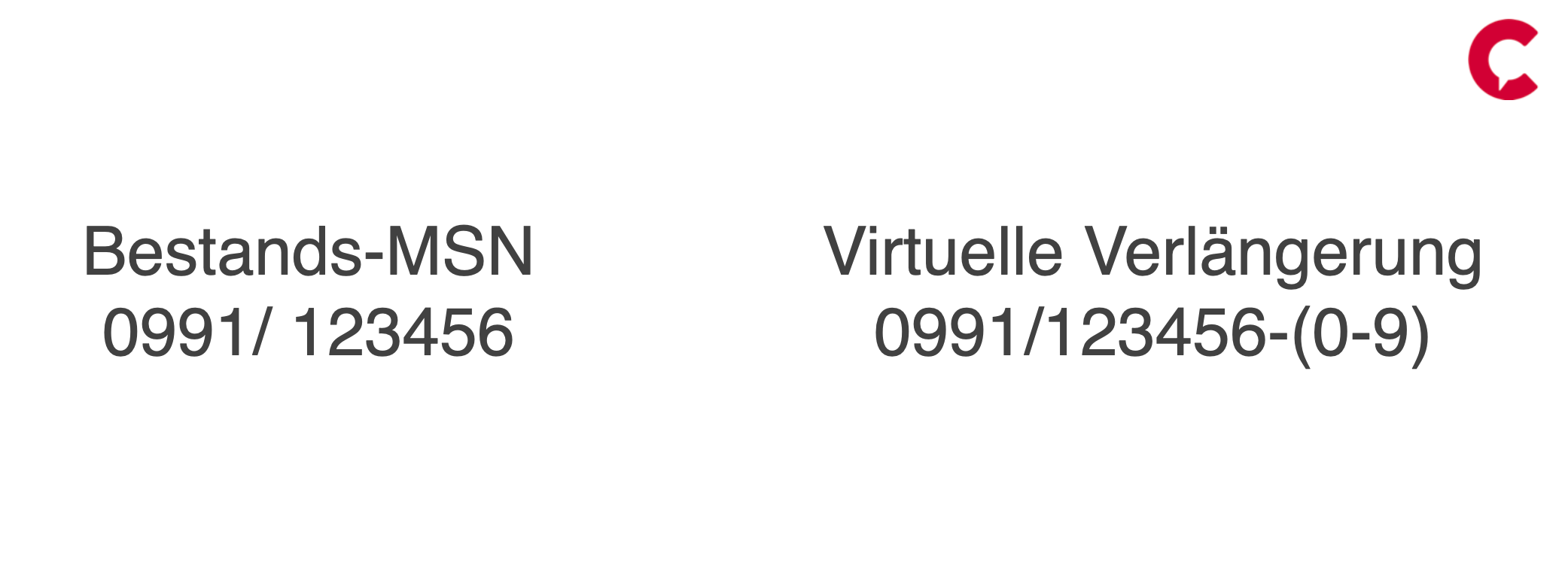
### Virtual extensions complicate the porting process
Virtual number extensions feel like a number block. The porting of a number block is then often triggered, but **virtual number extensions have changed a master number**. The porting request is rejected because not all relevant information was available. The exact definition of the virtual extensions and their assignment to the original base number is of crucial importance here.
It is also possible that not all providers may support the porting of such virtual numbers, especially if they extend beyond a certain range. One should therefore ensure that the provider supports such porting and that all necessary steps have been taken to ensure successful porting.
### SOLUTION - Previous synchronization of the phone number inventory
**Use the customer portal of existing providers**
The customer portal from an existing provider can help to make the number porting process efficient and smooth. An effective customer portal should provide a clear overview of the number inventory. This makes it easy to identify the numbers that are to be ported. This creates transparency and provides a central location for all relevant data.
**Master data query or an old order confirmation**
We have already mentioned the master data query above and it also serves as a reliable source here. In addition, an old order confirmation with identified phone numbers can be extremely helpful when porting phone numbers. The order confirmation is ideal for clearly identifying the phone numbers that are to be transferred as part of the porting process. Clear and precise information about the numbers to be ported is crucial to avoid confusion and errors. In addition, the existence and assignment of the phone numbers at a specific point in time is documented. In addition to the telephone numbers, the order confirmation can also contain technical details and additional services associated with the telephone numbers.
## Incorrect porting form
We basically distinguish between 2 types of porting. Namely **porting with simultaneous termination** and **number porting only**. These can each involve specific problems and reasons for rejection. In special cases, it even happens **that the connection has already been terminated** and the phone numbers are to be ported subsequently. In all cases, clear communication with both providers and a precise review of the contract documents and porting forms are crucial.
**Porting with simultaneous termination:**
A common problem with this type of porting is the **exact coordination of the notice periods and conditions** with the current provider. In addition, technical challenges can arise if the porting is not coordinated smoothly with the simultaneous termination. These include possible service interruptions or problems transferring telephone numbers seamlessly to the new provider. If the termination is not carried out correctly at the time of porting or if there are uncertainties regarding the contract terms, this can lead to rejections.
**Pure number porting:**
Here too, the contract terms and termination conditions must be observed to ensure that the porting complies with the contractual agreements. Technical compatibility between the transferring provider and the new provider is crucial. Pure number porting must meet all relevant compliance and legal requirements.
**Connection already terminated - Pure number porting**
In a special case where the connection has already been terminated, pure number porting (RRNP) plays an important role. Number porting only refers to the fact that only the telephone numbers are ported to a new provider. With some providers, **number-only porting** is not possible if the connection has already been terminated. This may be due to technical restrictions, different porting guidelines or tariff-dependent conditions. Before applying for porting, it is advisable to communicate with the transferring provider whether this option is available, especially if the line has already been terminated.
**What to do if pure number porting alone is not possible?**
If pure number porting alone is not possible, you should consider alternative solutions. This could include using a new line with the old provider or porting the phone numbers together with a new contract. Overall, number porting alone requires careful coordination with both providers to ensure that technical, tariff and contractual conditions are met.
## Other formal errors
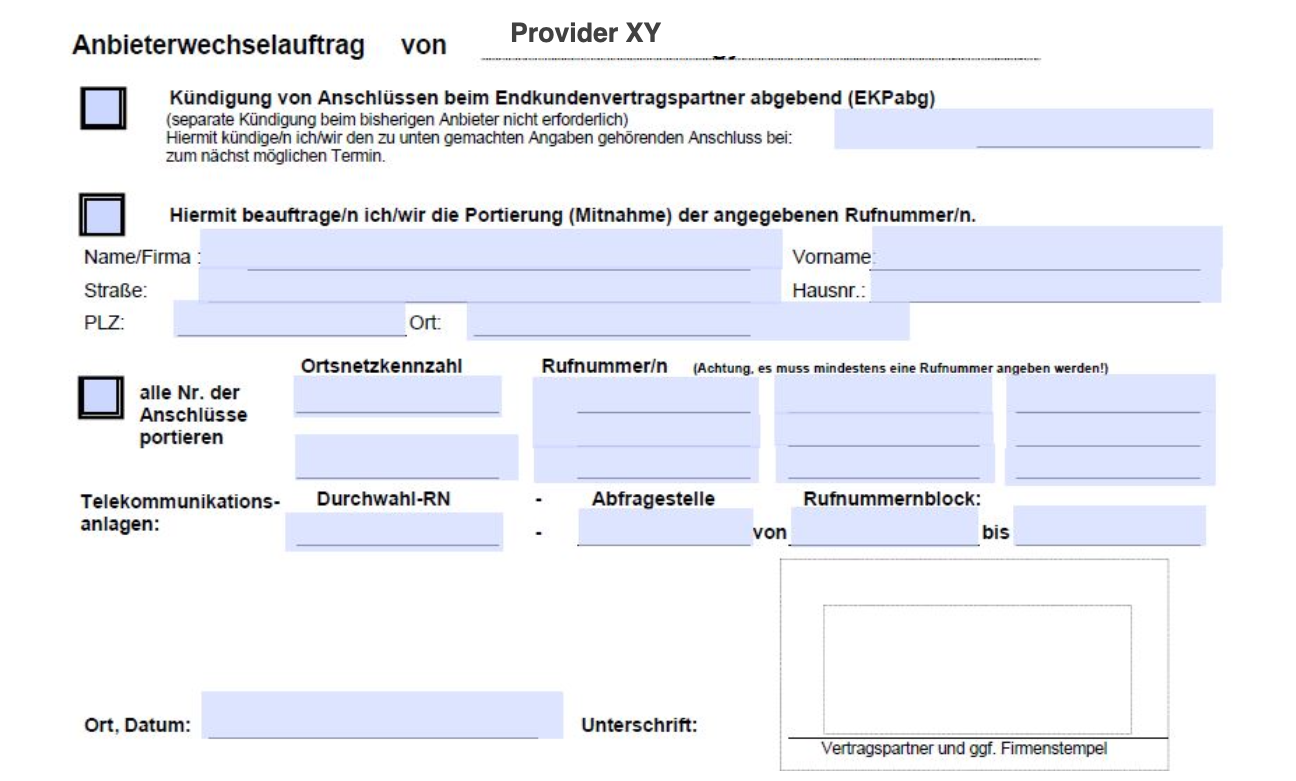
To avoid formal errors and ensure successful number porting, it is important to fill out the porting order carefully, check all the required information and make sure that it can be read by the transferring provider. A porting order must contain all the necessary information clearly and completely.
**The signature or company stamp is missing**
Almost more important than the signature, the company stamp is sanctified on the porting request. The absence of a signature and/or company stamp on a porting request generates a 100% rejection, as these elements are considered essential parts of the application process. The signature and company stamp make the porting order legally binding. This shows that the applicant has understood the conditions of the porting and agrees to them.
**Filling out the porting application beyond the specifications**
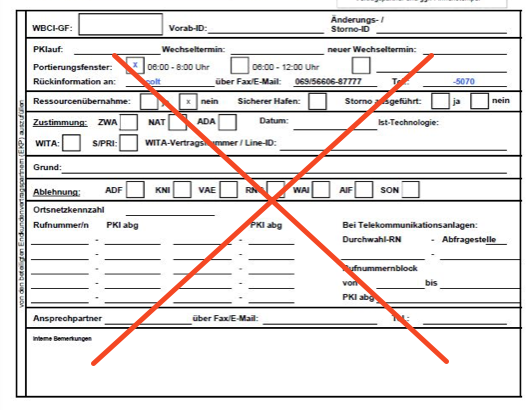
Filling out the porting form beyond the specified requirements will result in the porting being rejected. The lower section of a porting request is used for internal processing by the transferring and receiving provider. Even if pre-filling this information is perhaps well-intentioned, further processing will not be possible. It is therefore best to keep your hands off it.
**Uploaded scan of the porting request not readable**
Blurred or pixelated text in the porting order can lead to a rejection, as further verification is difficult or even impossible. This is often referred to as unclear consent, which calls into question the legally binding nature of the porting order. To ensure successful number porting, the scan of a porting request must be of good quality so that all information is clearly legible, especially when it comes to phone numbers, contract partner data and signatures.
---
# Agent Instructions
This documentation is published with GitBook. GitBook is the documentation platform designed so that both humans and AI agents can read, navigate, and reason over technical content effectively. Learn more at gitbook.com.
## Querying This Documentation
If you need additional information that is not directly available in this page, you can query the documentation dynamically by asking a question.
Perform an HTTP GET request on the following URL with the `ask` and `goal` query parameters:
```
GET https://docs.pascom.net/en/account/mypascom-userguide/porting-problems.md?ask=&goal=
```
`ask` is the immediate question: it should be specific, self-contained, and written in natural language.
`goal` is what the user is ultimately trying to achieve, the reason they need the answer. Sharing it helps GitBook give you a better, more relevant answer. A goal is most helpful when it describes the outcome the user wants rather than restating the question. For example, with `ask=how do I create an API token`, a goal like `build a script that syncs our docs to a CMS` lets GitBook tailor the answer to that use case.
The response will contain a direct answer to the question and relevant excerpts and sources from the documentation.
Use this mechanism when the answer is not explicitly present in the current page, you need clarification or additional context, or you want to retrieve related documentation sections.